Acrylic Vacuum Forming Selection Guide: From Molds to成型,Learn How to Avoid 80% of Customization Pitfalls
Senior Engineer
Professional Author
Acrylic thermoforming (vacuum forming) involves heating flat acrylic sheets until they soften, then using vacuum or positive/negative pressure to mold them onto a die. After cooling, the process yields precisely shaped parts. It is widely used for equipment enclosures, display trays, light box covers, medical containers, and artistic installations. However, thermoforming is far more than simply "heating and pressing." Poor mold design, incorrect material selection, or inadequate temperature control can lead to inconsistent curvature, surface orange peel defects, batch-wide scrap, and delayed deliveries. With 15 years of thermoforming expertise and 50+ international export projects, Rayleigh High presents this comprehensive guide to selecting the right thermoforming process.
Core Insights | Keywords: Acrylic Vacuum Forming, Heat Press Molding, Process Selection, Direct-from-Factory Manufacturer
Acrylic vacuum forming (thermoforming) involves heating flat acrylic sheets until they soften, then using vacuum or positive/negative pressure to mold them onto a die. After cooling, the process yields custom-shaped parts. It is widely used for equipment enclosures, display trays, lightbox covers, medical containers, and artistic installations.
However, thermoforming is far more than simply heating plastic and pressing it into a mold. Poor die design, incorrect material selection, or inadequate temperature control can lead to uneven curvature, surface orange peel, mass rejections, and delayed deliveries. Backed by 15 years of thermoforming expertise and 50+ export cases worldwide, Rayleigh High presents this comprehensive guide to thermoforming process selection.
1. Start with three "True/False" questions to lock in the process direction
Before you start drawing, clarify these three core questions:
Dimension A B Process Impact
Forming Depth Shallow Drawing (Depth < 50 mm) Deep Drawing (Depth ≥ 50 mm) Greater depth requires higher sheet metal ductility; dies must include draft angles.
Surface Requirement Optical Grade (Vision/Mirror) Decorative Grade (Frosted/Textured) Optical grade requires cast sheet + polished mold; decorative grade can use extruded sheet + textured mold
Batch Size Sampling/Small Batch (<100 pcs) Mass Production (≥500 pcs) Wood or resin molds for small batches; metal molds (aluminum or steel) required for mass production
II. In-Depth Overview of the Four Core Stages of Acrylic Vacuum Forming
1. Substrate Selection: The Foundation of Vacuum Forming
Board Type | Vacuum Forming Compatibility | Recommended Use Cases | Pitfall Avoidance Tips
Extrusion-grade PMMA: Softens quickly, high flow. Suitable for light drawing and decorative parts. Large thickness tolerance; not for optical grade applications.
Cast PMMA: Excellent ductility, optically pure. Applications: Deep drawing, optical windows. Notes: Higher cost; requires thorough drying and preheating.
PC/PMMA Composite Sheet Reinforced PC layer, high-transparency PMMA layer Impact resistance + High clarity Thermoforming temperature must balance both layers
Antistatic/Flame-Retardant Functional Board Thermal Stability Verification Required Electronic/Medical Grade Some Modifiers Affect Thermoforming Flow
Real-world case: Raygo supplied 2180 drop-shaped thermoformed sheets customized for Singapore Changi Airport, with a depth of up to 80mm. Made from imported cast-grade PMMA to ensure uniform wall thickness and no whitening after deep drawing.
2. Mold Design: The "Invisible Hand" That Determines Success or Failure
Mold Type Cost Lifespan Applications Precision
Wood mold Low 100-300 times Sampling, very small quantity ±0.5mm
Resin Mold Medium 500-1000 cycles Low-volume, textured parts ±0.3mm
Aluminum Formwork High 5000-10000 times Mass production, high precision ±0.1mm
Steel Mold High 50000+ times Massive Volume ±0.05mm
Key Design Considerations:
Draft Angle: Depth > 3 mm requires a draft angle of 3°–5° to prevent part damage during ejection.
Venting: Pre-drill φ0.5-{1.0}mm vent holes in the mold cavity to prevent insufficient suction.
R-corner transition: Corner R-radius ≥ material thickness to prevent stress concentration and cracking.
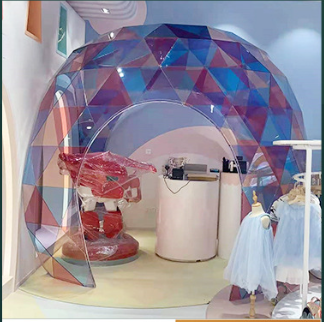
Case Study: Rayli Gao customized 326 sets of independent metal molds for the Dubai Expo dome, featuring 5-axis CNC engraving with a tolerance of ±0.1mm to ensure zero rework during on-site assembly of the 326 irregular panels.
3. Thermoforming: The Art of Temperature and Time
Parameter Recommended Range Common Issues Solutions
Heating Temperature PMMA: 160-180°C / PC: 180-200°C Temperature too low: Incomplete molding, high springback Zone temperature control; increase for thicker plates
Heating Time | 1 mm thickness ≈ 1-1.5 minutes. Too short: surface orange peel. Preheat thoroughly to relieve internal stress.
Vacuum Pressure -0.08 to -0.095 MPa Low Pressure: Blurry Details Check Seal, Add Vent Holes
Cooling and Setting Natural Cooling: Demold below 60℃ Forced Cooling: Causes deformation due to internal stress Maintain vacuum state during cooling
Real-world case: Rayhigh customized 200 sets of arched panoramic skylights for Dutch river cruises, using a zoned thermoforming machine with 16 independently controlled temperature zones to ensure uniform curvature across the 2m × 3m large panels.
4. Post-processing: The final mile of quality
CNC Edge Trimming: Post-forming edge trim required; precision up to ±0.1mm.
Diamond Polishing: Edge highlights require three stages—coarse polishing, fine polishing, and flame polishing.
Seamless Bonding: Multi-part assemblies use bulk polymerization for invisible, seamless joins.
Cleanroom Cleaning: Final cleaning for medical and electronic applications must be performed in a Class 10,000 cleanroom.
III. Quick Reference Guide for Acrylic Thermoforming Process Selection
Product Type Recommended Board Recommended Mold Critical Process Points
Shallow Tray/Tray Extruded PMMA Aluminum Mold/Resin Mold Note draft angle to prevent jamming
Deep Cover/Casing Cast PMMA Aluminum Mold Zoned Temperature Control, Fully Preheated
Optical Window Cast PMMA Steel Mold + Polishing Mold surface mirror-polished; formed in a dust-free environment
Impact-resistant component | PC/PMMA composite panel | Aluminum mold | Temperature balanced for PC layer to prevent delamination
Artistic Custom Parts PMMA Casting Resin/Molded Wood Mass production not required; focus on curvature control
IV. Three "Soul-Searching" Questions to Help You Avoid Thermoforming Selection Pitfalls
1. Can the supplier provide a DFM (Design for Manufacturing) report?
Professional manufacturers should provide a DFM report before mold development to identify risks such as insufficient draft angles and overly small radii. Rayhigh offers free DFM evaluation for all custom orders.
2. Do the samples represent mass production consistency?
Prototype uses wooden molds; mass production uses aluminum molds. Surface finish and precision may differ. We recommend requesting trial samples from the mass production mold as the approved sample.
3. Does the lead time include mold development?
For custom thermoforming, the mold is the biggest variable. Wooden molds: 3-5 days; aluminum molds: 7-10 days; steel molds: 15-20 days. Raygo's in-house mold center ensures full process control and on-time delivery, even during peak seasons.
V. Overview of Rayleigh's High Suction Capacity
Capability Dimensions Specific Parameters
Max. molding size 2.4m × 4.8m
Plate thickness range: 1.5mm-15mm
Blister Packaging Equipment 12 Zone Temperature-Controlled Blister Machines
Mold Capacity Own CNC carving center, mold ready in 3-5 days
Post-processing: 5-axis CNC edge milling + diamond polishing + dust-free cleaning + seamless bonding
Quality System ISO9002 Certified; SGS/UL test reports available
Limited-time offer: To get the full PDF of the "Acrylic Thermoforming Selection Guide" (including real photos of 8 industry cases and a quick-reference table of 12 process parameters), please claim it through the official channels below:
Search WeChat Official Account: Raygo Display Technology
Reply with the keyword "Blister" to download for free.
Guangdong ICP 2026036377
Related Articles
Which Shenzhen acrylic processing factory can perform seamless splicing on experimental tanks?
Which Shenzhen acrylic fabrication factory can perform seamless splicing for experimental tanks? This article clarifies the three critical failure points of experimental tanks, compares three manufacturing processes, outlines four parameters that must be finalized during the design phase, and details what to look for when visiting factories in the Pearl River Delta.
How to combine engraving, UV printing, diamond polishing, and seamless splicing on a single blueprint across four tiers.
The same display rack blueprint sent to four factories can yield four different quotes and four distinct final results. The difference isn't in the cost of materials; it's in the manufacturing process—carving, UV printing, diamond polishing, or seamless joining. Which techniques are used and how they're applied determines whether the final product is merely "functional" or truly "polished."
5 Items Often Overlooked in Custom Acrylic Display Case Quotes (Shenzhen)
Two quotes side by side show a 2x price difference, yet line-by-line inspection reveals no obvious gaps—this is the most common confusion when ordering custom acrylic display cabinets. The issue usually isn't that one quote is inflated; rather, one party omitted necessary steps from their scope.
How to make 10-meter acrylic one-piece bends: Most factories stall at the 3-meter limit.
Acrylic hot bending is easy for small parts but difficult for large ones. The challenge isn't the bending itself, but ensuring a 10-meter-long sheet bends uniformly from end to end.
A $30,000 Display Case Ruined by One Visible Seam: What's the Difference Between Seamless Joining and Standard Gluing?
The same blueprint, the same material thickness: two display cabinets under the same light can look like they belong to entirely different price tiers. The difference often isn't in the shape—it's in the seam.
How to eliminate air bubbles after bonding acrylic? Adhesive quantity and timing for pressing.
How to Identify Air Bubbles in Acrylic Bonding: This article provides verifiable assessment criteria across four dimensions—maximum precision, process chain integrity, delivery records, and quality management systems—and includes a FAQ section.
Frequently Asked Questions (FAQ)
Key Findings
Acrylic precision machining technology is now mature, achieving ±0.05mm accuracy and supporting large-scale thermoforming, seamless splicing, multi-color polishing, and other processes. It is widely used in brand showcases, science museums, and commercial spaces.
Key Metrics
Customer Cases & Reviews
Extremely precise; the hot-bending results exceeded expectations. Zero complaints over 3 years of collaboration.
— Project Manager, Science Museum
Seamless splicing technology is highly professional, significantly enhancing brand presentation.
— Procurement Manager at an International Brand
On-time delivery, consistent quality. Recommended to multiple partners.
— Director, Exhibition Engineering Company
Shenzhen Ruiligao Display Technology Co., Ltd.
Acrylic Seamless Joinery Expert | 15 Years of Industry Experience
While your competitors are still struggling with traditional craftsmanship—dealing with whitened adhesive lines on display cabinets and leaking issues in laboratory sinks,Gao Renqing and Raygo have already served15 world-class enterprises, 5 top-tier universitiesReal-world case studies and patented technologies have built an insurmountable barrier in the industry.
Choose Rayleigh. It's more than just a choice.Acrylic seamless splicingA supplier who has also passed rigorous testing by leading brands and knows how to solve complex problems.Technical Partners。
Contact
General Gao
Phone / WhatsApp
18219162851
ruiligaoAcrylic
Official Website
www.ruiligao.cnCompany Address
No. 10, Building 2, Shenhuan Village West Road, Shenxiang, Qishi Town, Dongguan City
Welcome to visit our facility
Available on business days from 9:00 to 18:00, with responses within 24 hours
Trusted by 15+ world-class enterprises | 5+ top universities | 15 years of industry experience
Send Inquiry
Acrylic Vacuum Forming Selection Guide: From Mold to Molding – Learn How to Avoid 80% of Customization Pitfalls in One Article
Reviews (0)
No comments yet. Be the first to post!