"Why is it 40% more expensive than small factories?" Facing the five tough questions from the CEO of a 50+ lab, I simply pulled up our factory's live surveillance feed.
Senior Engineer
Professional Author
Director Wang's "five burning questions" are exactly what every lab procurement manager is asking. Today, I'll lay them out plainly—no PPTs, no hype. Instead, we'll answer using real factory footage, test reports, and lessons learned from customers. Let's turn trust into proof you can see.
Dear Lab Directors and Procurement Heads, hello. I am Lao Zhou, founder of Raygo Laboratory Equipment.
Last week, CEO Wang from a biopharmaceutical R&D center came for a factory audit. His first words upon sitting down were:
"Old Zhou, I know you've built display cases for over 50 labs, but your quote is 40% higher than another vendor. Give me 5 reasons why I should buy from you. What exactly makes your factory better?"
Director Wang's "five burning questions" are exactly what every lab procurement manager is asking. Today, I'll lay them out plainly—no PPTs, no hype. Instead, we'll answer using real factory footage, test reports, and lessons learned from customers. Let's turn trust into proof you can see.
Issue 1: How can you guarantee your boards won't yellow? I can't tell the difference by eye.
Mr. Wang's pain point: The display case he bought earlier turned yellow like overnight tea after just six months, making it impossible to see the petri dishes inside.
Our answer — seeing is believing:
Mr. Wang, please follow me to our raw materials warehouse.
(Pointing to the stacking area) This stack is Mitsubishi's original imported cast plate; the label shows the batch number and customs declaration. The stack next to it is recycled material we purchased from the market — as you can see, it has already turned slightly yellow.
We cut small samples from two stacks in front of you and place them in a UV aging chamber. The test runs for 48 hours under accelerated conditions, equivalent to 3 months of natural sunlight exposure.
Result: The recycled material turned cloudy dark yellow; our Mitsubishi board showed almost no change.
More importantly, every batch of boards comes with a "Material Commitment Letter" included in the contract: "If recycled materials are detected, we will return the entire batch and compensate you three times the value."
It's not that we're bold; every board we source is fully traceable to its manufacturer, batch number, and MSDS.
See it to believe it: Don't just take "we use new material" at face value. Ask suppliers for brand names, customs declarations, and UV comparison test results. Third-party inspections are welcome.

Question 2: You claim seamless integration prevents leaks. How can I be sure it's not just glued together?
General Manager Wang's pain point: Previous suppliers claimed "seamless," but acetone leakage occurred within six months, nearly causing a fire.
Our answer — seeing is believing:
This is the easiest part. Mr. Wang, let me show you two things:
First, the process video. This is a real-time recording of our hot-melt welding: two acrylic sheets are heated to near-molting point and then bonded using a high-frequency press. Temperature, pressure, and duration are all digitally controlled. The seam has no adhesive layer; as you can see in the cross-section, it's indistinguishable from the solid sheet.
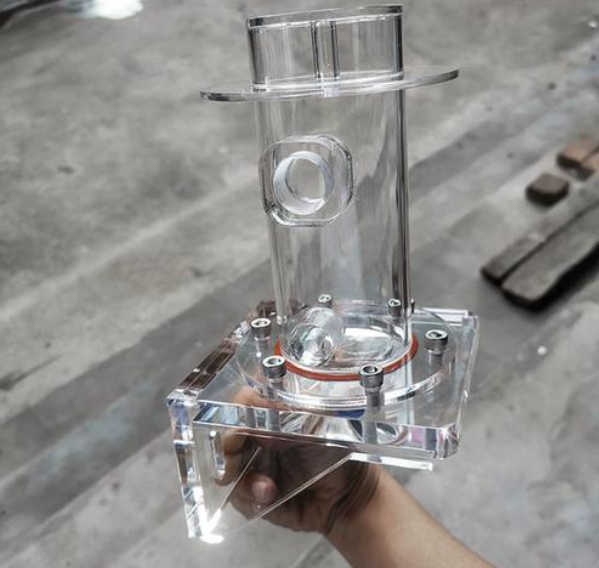
Second, on-site pressure testing. We have a newly fabricated sealed display cabinet filled with 20 kPa of compressed air and submerged in a water tank.
(Looking at the water surface) As you can see, there isn't a single bubble rising from the joint. We've also been maintaining pressure with this cabinet for 72 hours straight, and the pressure gauge needle hasn't moved an inch.
For the cabinet bonded with adhesive, we also prepared a comparison sample. After inflating it to the same level, tiny bubbles began appearing within 5 minutes. Upon opening the seam, the adhesive layer inside had turned white and crumbled into powder.
Our Promise: Before shipping, 100% of our sealed display cases undergo airtight testing and are accompanied by a numbered Pressure Retention Test Report. You can retest upon receipt.
See it to believe it: Require suppliers to provide pressure-holding test videos or live demonstrations. Any "seamless" product that cannot undergo pressure testing is a scam.

Question 3: How do you ensure the heat-bent area won't crack after two years?
Mr. Wang's pain point: The curved display stands he previously purchased developed spiderweb-like cracks at the top after just six months, eventually shattering completely.
Our answer — seeing is believing:
Mr. Wang, please take a look at this polariscope.
Here's a sample made with basic heat-bending: Look at the screen. The large rainbow-colored streaks at the bend indicate internal stress. As this stress slowly releases, cracking will inevitably occur within months to a year or two.
(Take our CNC hot-bending sample and place it here.) Take another look—the bend area is nearly dark black with no rainbow patterns, indicating extremely low stress and long-term durability.
The secret: our hot-bending machine features CNC ±2℃ closed-loop temperature control and stepped cooling after heating, allowing polymer chains to fully relax. In contrast, the single heating rods used by ad agencies suffer from ±20℃ temperature drift and rely on rapid water quenching—stress is inevitable.
See it to believe it: Request photos or videos of the heat-bent areas captured with polarized light from your supplier. If a factory lacks this equipment, recommend skipping them entirely.

Question 4: What makes your edge treatment special? Does it ensure no cuts and no bacterial buildup?
Key pain point for Mr. Wang: The lab requires frequent wiping with alcohol. Previously, the cabinet edges were rough; after just a few wipes, they began to turn white and fray from the edges.
Our answer — seeing is believing:
Mr. Wang, please run your finger along the cut edge of this display cabinet. Is it incredibly smooth, like touching glass? This is achieved using diamond polishing tooling with a precision of Ra 0.1μm, and all drilled holes feature rounded edges.
Touch the edges of a small manufacturer's product again — they're rough, chipped in places, and even leave powder residue when scratched.
These microscopic notches act as stress concentration points. When wiped with alcohol, microcracks propagate rapidly, causing whitening and fiber lifting. Additionally, these gaps trap dirt; under a microscope, they harbor bacteria.
Additionally, all shelves feature a tool-free snap-off design for easy removal and sterilization in an autoclave. All internal junctions are finished with R5 rounded corners to eliminate 90° dead zones where dust can accumulate.
See it to believe it: Wipe the cut edge a few times with a lint-free cloth. If threads snag on the cloth, the finish is substandard.

Question 5: What makes your factory stand out from others? Why should I trust you?


Executive Wang's pain point: "You make grand promises, but how can I guarantee the bulk order matches the sample quality?"
Our answer — seeing is believing:
Mr. Wang, that's exactly where we excel. Our management processes are stricter than those of many electronics manufacturers.
Let me show you three things directly:
1. First Article Inspection Record: For every order batch, the first item produced must pass four checks—dimensions, appearance, sealing, and stress—with recorded data and signatures. You can pick any record at random, and we will be able to identify the corresponding inspector.
2. Sample Sealing Room: We will label your confirmed samples with your name, date, and order number, then lock them in this cabinet. During mass production, workers must compare each batch against these sealed samples. If the final goods do not match the sample, we will remake them at no cost based on the sealed reference.
3. Quality Traceability Code: Each display cabinet's shipping order includes a unique code. Scan it to instantly identify the raw material batch, the welder, and the inspector involved. In case of quality issues, pinpoint the responsible party in under a minute.
More importantly, we're willing to write it into the contract:
• Warranty period: 2 years (industry standard: 1 years).
• For product quality issues (e.g., cracking, leakage) that damage your experimental samples, we cover direct losses up to 3 times the order amount.
• Retain 5% as a warranty deposit; release it after one year if no issues arise.
See it to believe it: Ask any of our client labs, such as the Institute of Crystal Materials, XX Biomedicine, or the Chemistry Department at XX University. We'll provide contact details for 5 clients so you can call them directly.
Summary:
Mr. Wang, you asked, "Why should I spend 40% more to buy your products?"
Every extra dollar you spend is buying "no problems."
No issues — panels remain non-yellowing for three years, ensuring observation data remains unaffected.
No leaks, no corrosion — joints stay sealed to protect expensive equipment.
No breakage: The curved section won't crack on its own, protecting your precious specimens from damage.
No issues — smooth, rounded edges with no hard-to-reach corners prevent bacterial overgrowth.
No surprises — bulk orders match samples exactly. No "buyer show" vs. "seller show."
Lab display cases aren't fast-moving consumer goods; they safeguard your samples and ensure the integrity of your research results. Choose a factory confident enough to let you see exactly what you're getting. You won't just save 40% on costs—you'll cut 100% of the hassle.
Rayleigh High Laboratory — Clear observations every time, safe samples always.
End-of-article bonus:
Follow this official account and reply "Factory Audit Checklist" to get our free "Laboratory Display Cabinet Supplier Audit Scorecard" (includes 25 checklists, ready to print).
The first 50 readers to reply will also receive a free "Existing Display Case Risk Diagnosis" (send us photos, and we'll help identify potential cracking or leakage risks).
Share this post to the lab group or on Moments, submit a screenshot via the backend, and be randomly selected from 3 winners to receive a physical copy of the "Lab Acrylic Application Manual."
Related Articles
Which Shenzhen acrylic processing factory can perform seamless splicing on experimental tanks?
Which Shenzhen acrylic fabrication factory can perform seamless splicing for experimental tanks? This article clarifies the three critical failure points of experimental tanks, compares three manufacturing processes, outlines four parameters that must be finalized during the design phase, and details what to look for when visiting factories in the Pearl River Delta.
How to combine engraving, UV printing, diamond polishing, and seamless splicing on a single blueprint across four tiers.
The same display rack blueprint sent to four factories can yield four different quotes and four distinct final results. The difference isn't in the cost of materials; it's in the manufacturing process—carving, UV printing, diamond polishing, or seamless joining. Which techniques are used and how they're applied determines whether the final product is merely "functional" or truly "polished."
5 Items Often Overlooked in Custom Acrylic Display Case Quotes (Shenzhen)
Two quotes side by side show a 2x price difference, yet line-by-line inspection reveals no obvious gaps—this is the most common confusion when ordering custom acrylic display cabinets. The issue usually isn't that one quote is inflated; rather, one party omitted necessary steps from their scope.
How to make 10-meter acrylic one-piece bends: Most factories stall at the 3-meter limit.
Acrylic hot bending is easy for small parts but difficult for large ones. The challenge isn't the bending itself, but ensuring a 10-meter-long sheet bends uniformly from end to end.
A $30,000 Display Case Ruined by One Visible Seam: What's the Difference Between Seamless Joining and Standard Gluing?
The same blueprint, the same material thickness: two display cabinets under the same light can look like they belong to entirely different price tiers. The difference often isn't in the shape—it's in the seam.
How to eliminate air bubbles after bonding acrylic? Adhesive quantity and timing for pressing.
How to Identify Air Bubbles in Acrylic Bonding: This article provides verifiable assessment criteria across four dimensions—maximum precision, process chain integrity, delivery records, and quality management systems—and includes a FAQ section.
Frequently Asked Questions (FAQ)
Key Findings
Acrylic precision machining technology is now mature, achieving ±0.05mm accuracy and supporting large-scale thermoforming, seamless splicing, multi-color polishing, and other processes. It is widely used in brand showcases, science museums, and commercial spaces.
Key Metrics
Customer Cases & Reviews
Extremely precise; the hot-bending results exceeded expectations. Zero complaints over 3 years of collaboration.
— Project Manager, Science Museum
Seamless splicing technology is highly professional, significantly enhancing brand presentation.
— Procurement Manager at an International Brand
On-time delivery, consistent quality. Recommended to multiple partners.
— Director, Exhibition Engineering Company
Shenzhen Ruiligao Display Technology Co., Ltd.
Acrylic Seamless Joinery Expert | 15 Years of Industry Experience
While your competitors are still struggling with traditional craftsmanship—dealing with whitened adhesive lines on display cabinets and leaking issues in laboratory sinks,Gao Renqing and Raygo have already served15 world-class enterprises, 5 top-tier universitiesReal-world case studies and patented technologies have built an insurmountable barrier in the industry.
Choose Rayleigh. It's more than just a choice.Acrylic seamless splicingA supplier who has also passed rigorous testing by leading brands and knows how to solve complex problems.Technical Partners。
Contact
General Gao
Phone / WhatsApp
18219162851
ruiligaoAcrylic
Official Website
www.ruiligao.cnCompany Address
No. 10, Building 2, Shenhuan Village West Road, Shenxiang, Qishi Town, Dongguan City
Welcome to visit our facility
Available on business days from 9:00 to 18:00, with responses within 24 hours
Trusted by 15+ world-class enterprises | 5+ top universities | 15 years of industry experience
Send Inquiry
Why Pay 40% More Than a Small Factory? After the CEO of Lab 50 fired off five tough questions, I showed them our factory's live monitoring feed.
Reviews (0)
No comments yet. Be the first to post!